
Pontiac City Directory Collections
Pontiac has an unusually long, uneven run of printed directories. The strongest local starting point is the Oakland History Center shelf list, which identifies city, telephone, and reverse directories held at Pine Grove. The collection begins with a Pontiac-Flint lead for 1860-61, continues through an 1886 Pontiac and Oakland County volume, and becomes much denser from 1895 through 1962. Each type answers a slightly different question. A standard Pontiac city directory is usually name-led; a reverse volume works from a house number and street; a telephone book can supply an address lead when a full directory is missing.
| Collection | Years | Where held | How to use it |
|---|---|---|---|
| Pontiac-Flint and Pontiac/Oakland city directories | 1860-61; 1886; selected 1895-1962 | Oakland History Center and related university leads | In-person shelf research; verify the specific volume |
| Polk's Pontiac City Directory | 1922, 1925, 1928, then selected 1935-62 | Oakland History Center | Household, street, and business clues |
| Pontiac telephone directories | 1931; selected 1935-44 | Oakland History Center | Telephone and address leads |
| Arrow Street Guide and criss-cross volumes | 1930; 1958, 1960; 1967-68 | Oakland History Center | Address-to-occupant research in person |
| Digitized Pontiac directories | Edition dependent, including 1927 full view | Google Books / University of Michigan source | Online OCR discovery, then scan verification |
| Pontiac newspaper microfilm | 1835-2019 | Pontiac Public Library | On-site use or a narrow staff search |
There is no evidence of one unbroken annual Pontiac city directory set. Treat an absent year as a gap in the shelf, publication, or access route until another source settles it. Later Bresser and Polk North Oakland runs from 1978-1998 are reported in an established genealogy catalog, but the exact local shelf status should be confirmed before making a trip.
Pontiac City Directory Publishers
The publishing sequence is a useful date check when two Pontiac volumes look alike. The 1895 directory bears J.H. Harger & Co.; W.W. Robertson appears in 1898; Pound & Dawson in 1902 and 1904; and Michigan Printing Co. in 1907, 1912, and 1915. R.L. Polk then becomes the familiar name across the later Pontiac runs. The 1904 volume also has a Pontiac City Directory Death List, a helpful companion when a person disappears between editions.
Publisher names do not identify a household by themselves. They do help distinguish an edition from a reprint, catalog record, or OCR result. The shelf list is the safer source for an exact year because the Oakland History Center newsletter summarizes some of the later Polk ranges. Pontiac's directory history runs from early local publishers to Polk, so cite the year, publisher, page, and the section used when preserving a research note.
- 1860-61: Pontiac-Flint City Directory provides the earliest local directory lead.
- 1895-1915: Harger, Robertson, Pound & Dawson, and Michigan Printing Co. mark the early Pontiac publishing sequence.
- 1922-1962: Polk editions become the main run, with selected years rather than a proven annual sequence.
- 1930: The Greater Pontiac Arrow Street Guide adds a reverse, street-oriented route.
- 1958-1968: North and South Oakland criss-cross volumes add further address-to-occupant access.
Note: A directory title can cover Pontiac alongside nearby communities, so record the city label printed in the volume rather than assuming every entry falls inside current city limits.
Pontiac City Directory Shelves
The Oakland History Center at Pine Grove, 405 Cesar E. Chavez Avenue, is the main room for Pontiac city-directory research. Its holdings also include obituary cards, family histories, land and tax material, county census resources, newspaper clippings, historic-home files, and local organization records. The listed office phone is 248-338-6732 and the email is office@ocphs.org. Hours are commonly Tuesday through Thursday, 11-4, but contact the center before relying on them. That contact step matters when a volume must be pulled from a shelf or when a precise edition is needed.
The History Center's online shelf list is a useful preparation tool before an in-person Pontiac directory visit.
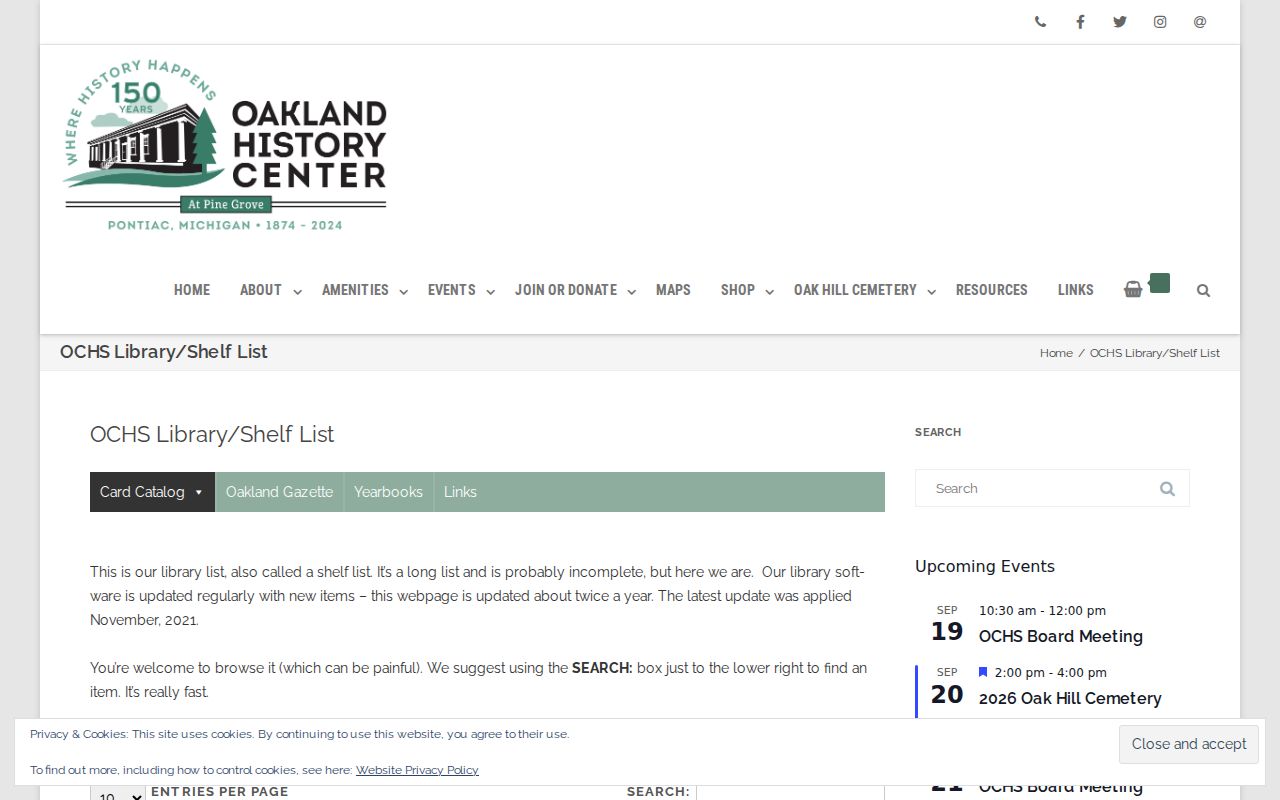
Use the list to make a short year-by-year request list, including the 1930 Arrow Street Guide or later criss-cross books when the question starts with an address. The research room has materials that an online name search will not reproduce, especially local clippings and historic-home references.
Pontiac Public Library supplies a different access channel. Its research resources include local history material, on-site genealogy databases, and microfilm from 1835-2019. Library staff can search a date-specific newspaper request for $3, but a request should include the month, year, approximate date, and a short description. Because reels are searched manually, the practical window is three days, not a broad decade. Article and obituary requests may also be made by mail with payment and a self-addressed stamped envelope.
Reading a Pontiac City Directory
A Pontiac city directory entry commonly begins with the name as printed, often a household head, followed by a street address and a brief occupation or business description. A spouse or family relationship may appear in parentheses. Historical runs can include a widow notation. Street direction is part of the evidence: E. Pike, W. Huron, N. Saginaw, and S. Perry are not interchangeable locations. An entry may appear in an alphabetical name list, a street list, a business section, or a telephone section depending on the edition.
| Name line | Copy the surname, initials, and punctuation as printed. OCR can merge or drop these marks. |
|---|---|
| Family notation | A spouse, relationship, or widow notation may appear. Confirm it in the page image. |
| Address | Preserve house number, street spelling, and E/W/N/S prefix. These can separate similar Pontiac entries. |
| Occupation or business | A short role or business clue can distinguish people with the same name, but it is historical context, not an identity claim. |
| Ownership mark | Some directories use marks such as h or r. Read that edition's front matter before assigning a meaning. |
- Criss-cross directory
- A reverse directory arranged by street and house number, used to find the occupant recorded at an address.
- Householder index
- The name-organized part of a directory that points from a person or household head to an address.
- Abbreviation key
- The front-matter legend that explains the shorthand used in that particular volume. Read it before interpreting a mark.
Local OCR makes this caution real. The digitized text includes shortened forms such as mach opr, slsmn, and tchr. OCR is useful for locating a possible page, but the scan controls the transcription. Some Pontiac directory pages mix household and business details, which is another reason to preserve the entry exactly before drawing a conclusion.
Pontiac City Directory OCR
The digitized Pontiac City Directories collection identifies the University of Michigan as the source and records a 2009 digitization date. The 1927 edition is identified as full view, while the 1931 result and other editions can be snippet or limited view. Availability changes by edition, so a search result is an invitation to check the page, not a guarantee that every page is readable online.
The digitized Pontiac city directory view can help locate an unusual surname, street, or local business term before a shelf visit.
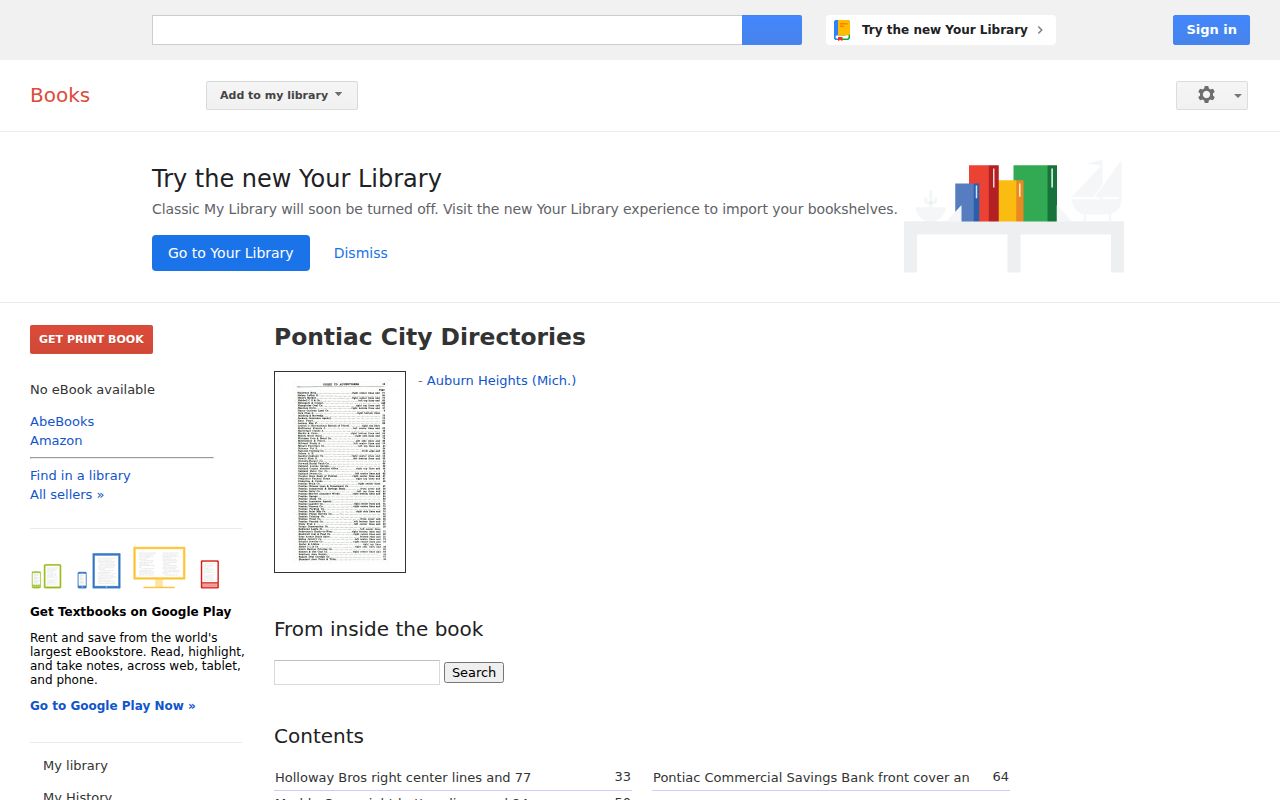
Match the OCR hit to the full page and front-matter key whenever access permits. A scan also preserves columns and page placement that OCR loses. For a detailed current parcel or address record, use the Pontiac street directory route instead of treating an old listing as a current record.
Note: Google Books can reveal a page quickly, while the History Center copy is the better route for checking a limited edition or uncertain abbreviation.
Tracing Pontiac City Directory Families
Follow one household across Pontiac city-directory years, but keep the time gaps visible. Start with the edition closest to a known event. Copy the address, initials, spouse notation, page, and street direction. Then move backward and forward through available runs. The 1930 Arrow Street Guide, 1958 and 1960 North Oakland criss-cross editions, and the 1967-68 South Oakland cross-index are useful when the name list is weak but the address is known.
- Find the person in a Pontiac volume close to a known date and read the edition's abbreviation key first.
- Record the printed name, address, family notation, page, and street direction exactly as shown.
- Check a reverse or criss-cross volume when an address needs an occupant lead.
- Compare available Pontiac runs on both sides of a move, rather than treating one missing entry as proof of departure.
- Pair the directory evidence with the closest released federal census, deed, permit, obituary, or newspaper notice.
The public federal census currently runs through 1950 under the 72-year rule. Census household composition, age, and birthplace can test whether two similarly named Pontiac directory entries belong to the same family. A directory occupant, a deed grantee, and the person named in a newspaper notice may be different people, so compare roles before merging them in a family history.
Pontiac City Directory Street Names
Street names carry local geography that OCR often weakens. Pontiac sources preserve E. and W. Pike, E. and W. Huron, N. and S. Saginaw, N. and S. Perry, Franklin Boulevard, Woodward Avenue, Baldwin Avenue or Road, Telegraph Road, Elizabeth Lake Road, Pontiac Lake Road, Joslyn, and Cesar E. Chavez Avenue. Preserve the direction and form printed in a directory. A person who appears on W. Huron is not necessarily the same entry as a person on E. Huron.
There is no verified single year for a Pontiac-wide renumbering or renaming program. When an older address does not line up with a modern one, compare nearby street entries, legal descriptions, the 1930 Arrow Street Guide, and local street research rather than inventing a conversion date. Pontiac's edge also meets Auburn Hills, Lake Angelus, Waterford Township, and Bloomfield Township, so the city label and postal label should be copied as printed.
Pontiac City Directory Gaps
Absence from a Pontiac city directory has several possible causes. The person may have moved, used a different initial, fallen outside the volume's coverage, appeared in a business section, or simply been missed by a publication. Some records are held only in person, and the library's microfilm is not digitized. The practical fallback chain is the History Center shelf, Pontiac Public Library microfilm and staff request, Google Books where an edition is open, then county land or court sources that fit the question.
Oakland County records reach back toward its founding period, but access is split between online systems and older paper or archival material. That split can explain a research gap without proving that a Pontiac person, household, or address never existed.
Note: A missing Pontiac entry can reflect publication or access limits, so preserve the date searched and the exact collection consulted.